2002 · Identity and context
Choose the key role and inspect the assignment
Compare asset, product-instance and physical-location roles without turning a displayed sample into an issued identifier.
Open a workspace beside this lesson. Protected links keep their existing access gates; no new permission is granted by this course.
Why this matters
The object’s role determines the applicable key type.
The EPC representation, GS1 element string and assignment state must travel together.
Read the screen with the explanation
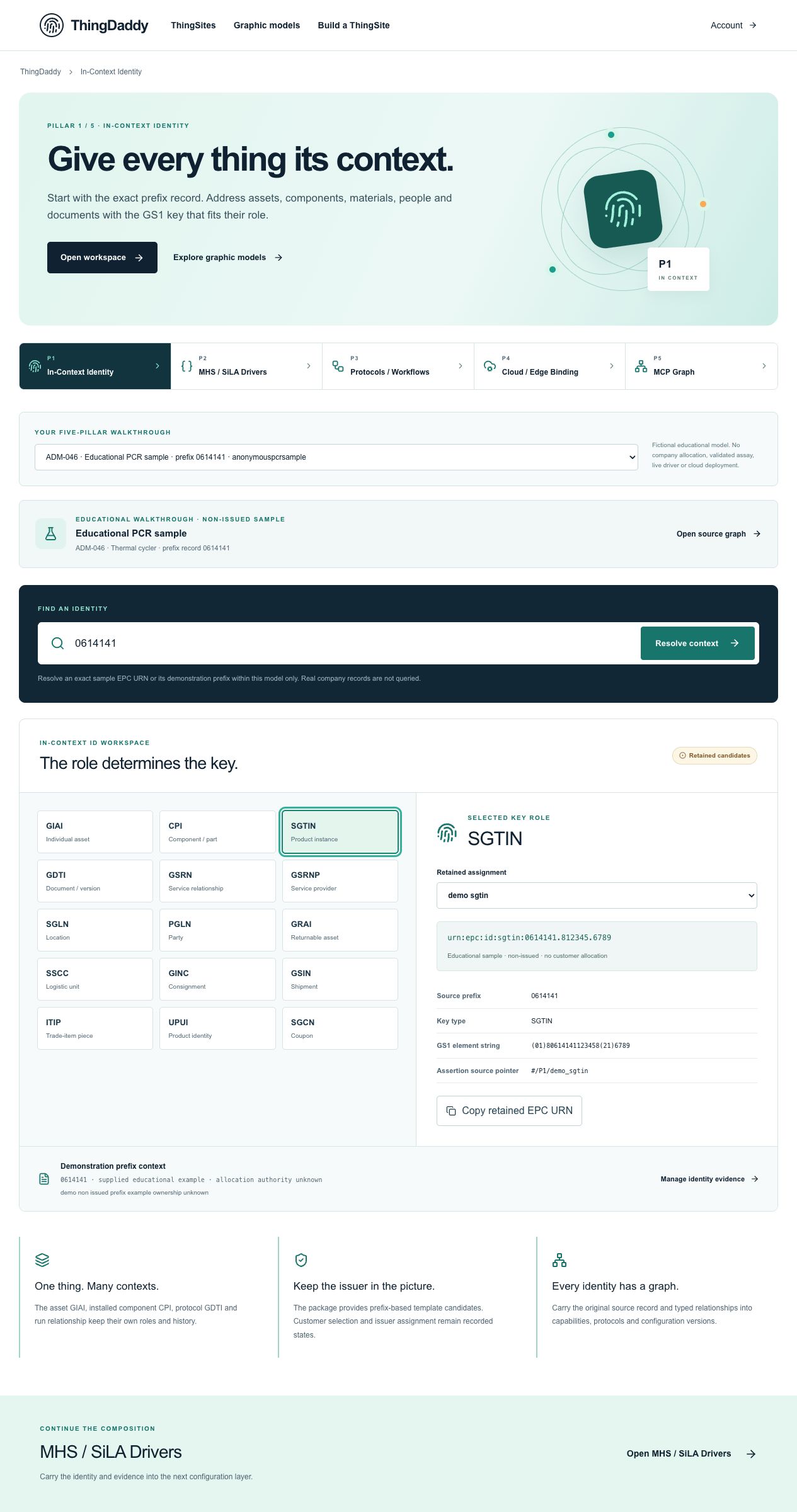
Earlier anonymous demonstration capture · Earlier local anonymous educational preview; not current physical execution or hosted acceptance · not evidence that this exercise has been performed. Open the image for full resolution.
Screenshot provenance
SHA-256 6b80ed898b9a721e5fcc9855254609919ae5413f0a63fe83e35a9f7f0e958d25Captured 2026-10-13T06:39:39.109Z. Source-package pin: 2f78a982141bda51ba64ea8ccb3a07f527eec3f77cf89baaa1f05c102197f6fd. Original screenshot bytes preserved.
Step by step
01 Select an asset role
Screen or control: GIAI · Individual asset
Why: An asset record must not be replaced by a product-model label.
How: Select GIAI in the key palette. Read Retained assignment, the full urn, source prefix, key type and GS1 element string.
What you should see: The first retained GIAI candidate uses urn:epc:id:giai:0614141.4 and element string (8004)06141414.
Verify: Record the selected assertion source pointer and the non-issued state beside the urn.
02 Inspect another occurrence
Screen or control: Retained assignment
Why: Repeated assertions may use the same identity but retain different source locations.
How: Open the assignment menu. Choose another cycler GIAI assertion occurrence and compare its source pointer with the first.
What you should see: The urn can remain equal while the assertion source pointer changes.
Verify: Explain why equal urn bytes do not authorize deleting one source occurrence.
03 Compare roles
Screen or control: SGTIN · SGLN
Why: A serialized product and physical location are not interchangeable identities.
How: Select each of these palette buttons in turn and record its urn and role. Read the source prefix independently.
What you should see: The representation changes with the selected role while the namespace is still 0614141. PGLN is not offered.
Verify: Confirm PGLN cannot be selected. Do not use an SGLN as a person, organization or machine identity.
04 Copy without assigning
Screen or control: Copy retained EPC URN
Why: Copying a string is not issuing or verifying a key.
How: Return to GIAI and use Copy retained EPC URN. Paste it into the resolver input and resolve the exact string.
What you should see: A successful clipboard action changes the control to Copied; the model remains non-issued.
Verify: Check issued:false and allocation_authority_evidence:null in the package JSON. No new assignment record should be claimed.
What is happening under the surface
GIAI identifies the example asset; SGTIN represents a serialized trade-item context; SGLN represents a physical location. PGLN is banned as a ThingDaddy ID type.
The key palette includes 14 supported EPC scheme roles. Its labels are teaching aids, not an assignment service. Original PGLN assertions remain excluded provenance, never active identities.
urn, value and element_string are distinct retained representations. The source prefix remains the namespace context rather than a composed party identifier.
Common mistakes
- The identifier is opaque; product behavior cannot be inferred from its digits.
- A successful copy or syntax-shaped display does not establish allocation authority.
- Optional logistics and coupon examples do not prove those roles apply to this PCR composition.
The records an agent needs
Compare the identity object at each exact pointer. PGLN is excluded by ThingDaddy policy, with no active identity, generation or resolution. The chosen UI scheme and its retained key_type can differ in vocabulary: CPI is the EPC scheme while the fixture records the component key as CPID. Do not silently rewrite either field.
Exact retained identities
urn:epc:id:giai:0614141.4urn:epc:id:sgtin:0614141.812345.6789urn:epc:id:sgln:0614141.41414.41Anonymous package occurrence pointers
#/P1/demo_giai#/P1/demo_sgtin#/P1/demo_sgln#/P1/manufacturerPrefixFields or record paths to inspect
key_typeroleurnvalueelement_stringstateissuedcustomer_reviewPointers locate records; hashes pin bytes; lesson numbers locate teaching material. None substitutes for an applicable assigned GS1 identity.
Apply what you learned
Create a three-row role map for GIAI, SGTIN and SGLN, with a separate PGLN exclusion note.
Prepare these outputs
- Role, full urn, source pointer and element string for each supported row.
- Assignment state and authority evidence for each.
- Explain why PGLN is not selectable and original assertions must remain excluded evidence.
Review your work against these checks
- The three supported roles remain distinct.
- All assignment evidence stays false or unknown as supplied.
- No missing field is filled using a familiar label.
Check your reasoning
What does Copy retained EPC URN establish?
This answer stays in page memory, is cleared when you leave, and is not sent or recorded as certification, validation or authority.Source and current boundaries
Screen basis: the anonymous public educational fixture at /api/demo/pillars, namespace 0614141. No private company record is read by this course.
Pinned assessed package SHA-256: b06ee255d0943a048511092595db4b98281b9b761d1910d19e6c3dba82591d94. Its complete graph contains 329 nodes and 231 directed relationships; original excluded assertions remain separately retained provenance. Lesson locators are educational numbers, not issued GS1 keys.
Scope: fictional authored records, non-issued identity proposals, unknown authority, no physical command, assay validation, cloud deployment or execution authorization.
fictional authored, non-issued, read-only
b06ee255d0943a048511092595db4b98281b9b761d1910d19e6c3dba82591d94Open primary referencePrimary standards reference; not allocation or issuance evidence for this sample
Open primary referencePrimary representation reference; original sample assertions and assignment states remain separate
Open primary referenceReading, answering a question and opening a diagram do not issue identifiers, validate a scientific method, establish company authority, commission an environment or authorize physical action.