2001 · Identity and context
Resolve an exact identity without inventing a match
Use the public identity workspace to distinguish a prefix-scoped list of assertions from an exact EPC identity lookup.
Open a workspace beside this lesson. Protected links keep their existing access gates; no new permission is granted by this course.
Why this matters
An agent needs an address, not a familiar product label.
A result count may describe repeated source assertions about one identity; it is not a count of verified physical units.
Read the screen with the explanation
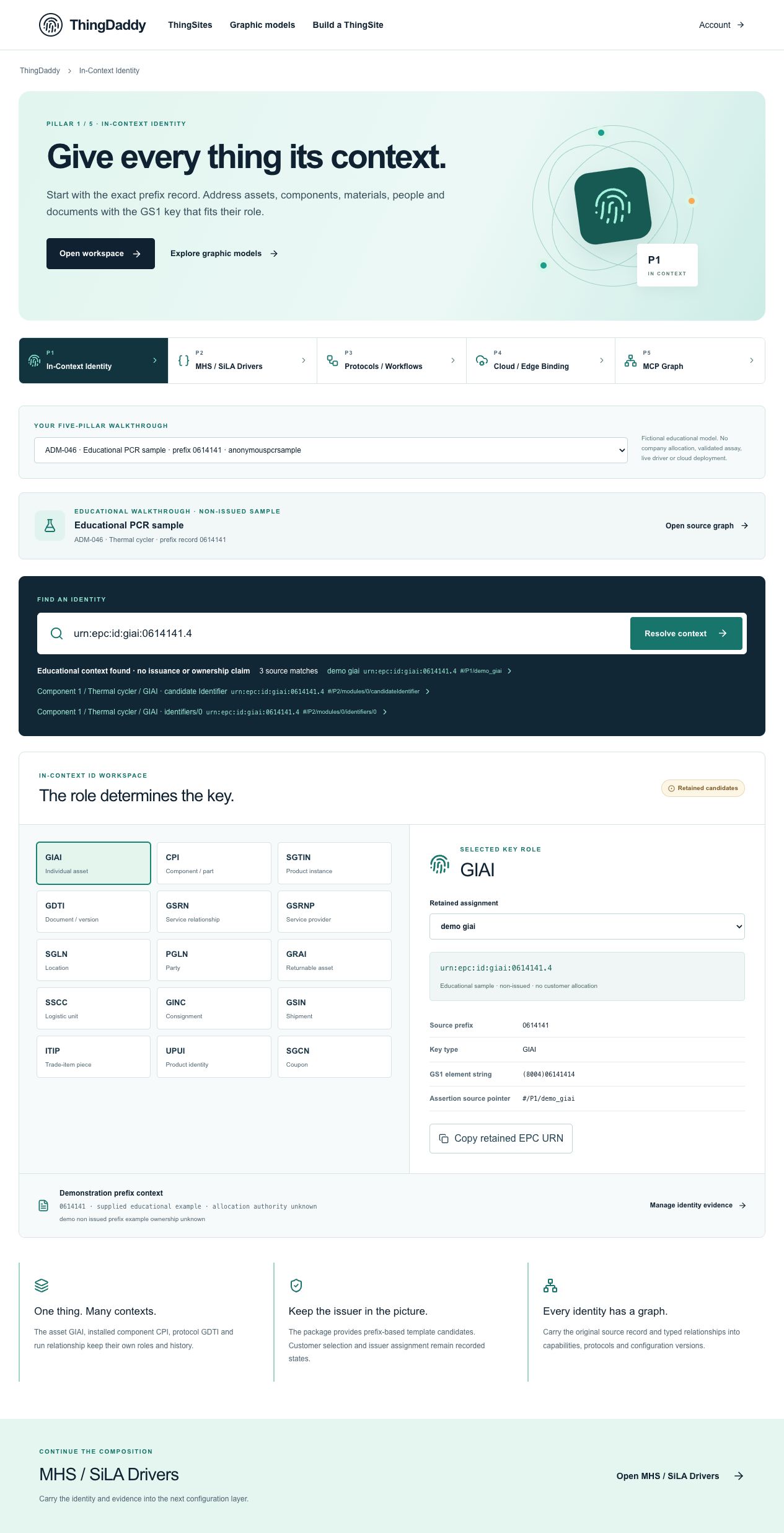
Earlier anonymous demonstration capture · Earlier local anonymous educational preview; not current physical execution or hosted acceptance · not evidence that this exercise has been performed. Open the image for full resolution.
Screenshot provenance
SHA-256 1e554f5987c892d50cf09e5db9d547abe7e4f4a5b5dee0e29165c85621701feaCaptured 2026-10-13T07:00:00.737Z. Source-package pin: 2f78a982141bda51ba64ea8ccb3a07f527eec3f77cf89baaa1f05c102197f6fd. Original screenshot bytes preserved.
Step by step
01 Open the identity workspace
Screen or control: P1 · Open workspace
Why: Start in the same educational namespace as the lesson.
How: Open the P1 screen link and scroll to Find an identity. Read the educational source bar before searching.
What you should see: The page identifies an educational, non-issued sample using prefix 0614141.
Verify: Confirm the page says real company records are not queried; do not sign in to a private site for this exercise.
02 Inspect the prefix result
Screen or control: Demonstration prefix or exact EPC URN · Resolve context
Why: A prefix scopes assertions but does not identify one physical asset.
How: Enter 0614141 and select Resolve context. Inspect the listed urn values and their source-pointer labels.
What you should see: The educational resolver lists all retained candidate assertion occurrences in this prefix-scoped sample.
Verify: Identify at least two different occurrence pointers. Do not relabel the match count as installed instruments or valid allocations.
03 Resolve the exact cycler address
Screen or control: Demonstration prefix or exact EPC URN · Resolve context
Why: Exact equality prevents a label-based identity substitution.
How: Replace the input with urn:epc:id:giai:0614141.4 and resolve again. Compare any repeated occurrences carrying that exact urn.
What you should see: Only assertions carrying the exact sample GIAI match; repeated assertions can refer to the same address.
Verify: Record each occurrence pointer separately and confirm the full urn, including the leading zero, is unchanged.
04 Test an unknown address
Screen or control: Demonstration prefix or exact EPC URN · Resolve context
Why: A failed lookup should expose uncertainty, not guess a nearby thing.
How: Search for urn:epc:id:giai:0614141.999999, then restore the exact cycler address.
What you should see: The unknown address produces no exact identity in this sample. Restoring the known address restores its assertions.
Verify: Capture both outcomes and confirm the unknown address was not mapped to Thermal cycler by its name.
What is happening under the surface
The supplied example prefix is 0614141, retained with ownership unknown. It is not a party identifier; PGLN is banned as a ThingDaddy ID type.
P1 and P2 retain separate assertion occurrences even when their urn values are equal. A source-pointer occurrence and an asset identity answer different questions.
Common mistakes
- Trimming the leading zero changes the address.
- A prefix match is not proof of prefix ownership.
- The result links open the public graph; they do not authenticate or allocate a private ThingSite.
The records an agent needs
The resolver compares exact retained urn strings in the loaded public model. The three example pointers identify three assertions, not three independently verified units. allocation_authority_evidence is null and issued is false.
Exact retained identities
urn:epc:id:giai:0614141.4Anonymous package occurrence pointers
#/P1/demo_giai#/P2/modules/0/candidateIdentifier#/P2/modules/0/identifiers/0#/P1/prefixEvidenceFields or record paths to inspect
urnsource_prefixstateissuedallocation_authority_evidenceidentity_equivalence_assertedPointers locate records; hashes pin bytes; lesson numbers locate teaching material. None substitutes for an applicable assigned GS1 identity.
Apply what you learned
Prepare an exact-resolution receipt for the known and unknown addresses.
Prepare these outputs
- Input strings and visible outcomes.
- The exact known GIAI and three distinct occurrence pointers.
- A one-sentence explanation of assertion count versus asset count.
Review your work against these checks
- The unknown lookup remains unknown.
- Every copied urn keeps 0614141 exactly.
- No issuance, ownership or real installation claim is made.
Check your reasoning
Three source occurrences carry the same sample GIAI. What can you conclude?
This answer stays in page memory, is cleared when you leave, and is not sent or recorded as certification, validation or authority.Source and current boundaries
Screen basis: the anonymous public educational fixture at /api/demo/pillars, namespace 0614141. No private company record is read by this course.
Pinned assessed package SHA-256: b06ee255d0943a048511092595db4b98281b9b761d1910d19e6c3dba82591d94. Its complete graph contains 329 nodes and 231 directed relationships; original excluded assertions remain separately retained provenance. Lesson locators are educational numbers, not issued GS1 keys.
Scope: fictional authored records, non-issued identity proposals, unknown authority, no physical command, assay validation, cloud deployment or execution authorization.
fictional authored, non-issued, read-only
b06ee255d0943a048511092595db4b98281b9b761d1910d19e6c3dba82591d94Open primary referencePrimary standards reference; not allocation or issuance evidence for this sample
Open primary referencePrimary representation reference; original sample assertions and assignment states remain separate
Open primary referenceReading, answering a question and opening a diagram do not issue identifiers, validate a scientific method, establish company authority, commission an environment or authorize physical action.