2004 · Identity and context
Separate service relationships, run bindings and document versions
Explain GSRN, SRIN, protocol-family GDTI, protocol-version GDTI and configuration GDTI as different identities with different jobs.
Open a workspace beside this lesson. Protected links keep their existing access gates; no new permission is granted by this course.
Opening the fixed anonymous evidence graph…
Why this matters
An agent must know which exact configuration a service instance concerns.
Versioning a document must not overwrite a service relationship or turn a file hash into a GS1 identity.
Read the screen with the explanation
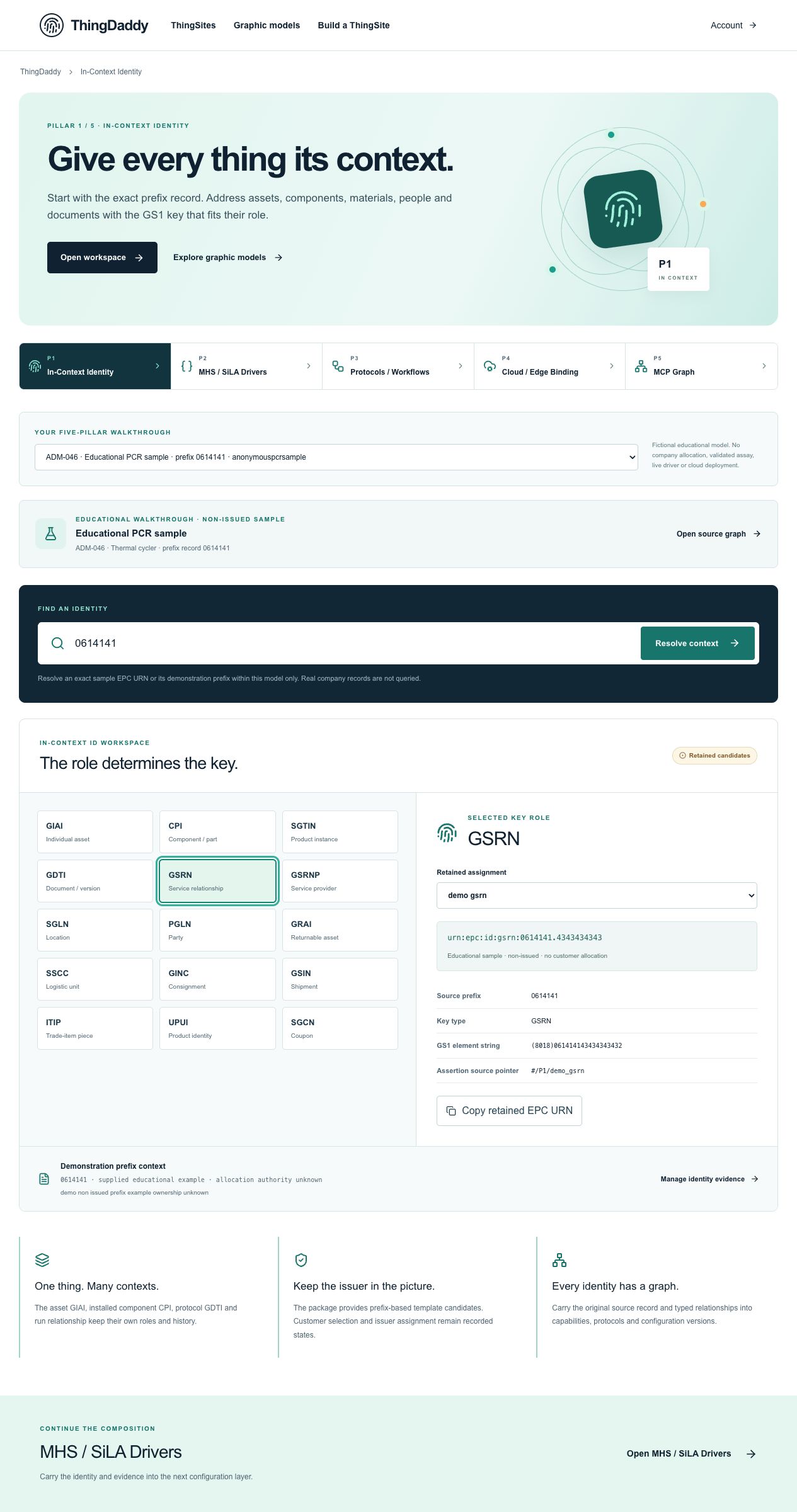
Earlier anonymous demonstration capture · Earlier local anonymous educational preview; not current physical execution or hosted acceptance · not evidence that this exercise has been performed. Open the image for full resolution.
Screenshot provenance
SHA-256 71685c8510faeb528cddc118d4610d039dc849eeabfed3b605ca988e1a609f1fCaptured 2026-10-13T06:39:39.811Z. Source-package pin: 2f78a982141bda51ba64ea8ccb3a07f527eec3f77cf89baaa1f05c102197f6fd. Original screenshot bytes preserved.
Step by step
01 Inspect the service relationship
Screen or control: GSRN · Service relationship
Why: A relationship identity does not by itself authorize an operator.
How: Choose GSRN in P1. Record the operator relationship urn, assignment state and source assertion pointer.
What you should see: The retained GSRN is urn:epc:id:gsrn:0614141.4343434343, non-issued with authority evidence absent.
Verify: Do not infer employment, competence or execution permission from this record.
02 Inspect the document identities
Screen or control: GDTI · Retained assignment · Public package link
Why: Family, version and configuration documents have separate purposes.
How: In the GDTI assignment menu inspect configurationGdti and serviceBindingGdti. Open the public package link below to inspect protocolFamilyGdti and candidate_workflow_gdti under P3; those two are not entries in this P1 assignment menu.
What you should see: Four separate document references remain available through their actual screen and package locations; selecting one does not replace the others.
Verify: Compare #/P3/protocolTemplates/0 protocolFamilyGdti and candidate_workflow_gdti with #/P1/configurationGdti and #/P1/serviceBindingGdti in package JSON.
03 Follow the exact version lineage
Screen or control: Protocol-version focused graph · Original direct relationships
Why: An explicit version-of edge is stronger than a similar title.
How: Open the protocol-version graph link and inspect version-of-protocol-family, then open its family destination.
What you should see: The version urn:epc:id:gdti:0614141.00011.1 points to family urn:epc:id:gdti:0614141.42424.42 through relationship GDTI 00900.9.
Verify: Record #/P5/edges/8 and keep family/version IDs separate. No version is inferred from the display name.
04 Inspect the missing run-instance boundary
Screen or control: Service-binding focused graph · Inspect exact JSON · Public package link
Why: The binding-document GDTI must not be misreported as an SRIN.
How: Open the binding graph link and inspect the relationship to the exact configuration. Check the public package for an actual SRIN field; note that none is supplied.
What you should see: The binding document urn:epc:id:gdti:0614141.00013.1 references configuration urn:epc:id:gdti:0614141.01200.1, but the public record does not assign an SRIN value.
Verify: Write “SRIN binding value not exposed in this public fixture”. Do not generate an urn:epc:id:srin address or invent a run.
What is happening under the surface
A GSRN addresses a service relationship; SRIN qualifies a particular instance of that relationship using AI 8019. SRIN is not a standalone invented EPC Pure Identity scheme.
The family, exact protocol version, configuration design and service-binding document have separate GDTIs in this sample.
The public anonymous package exposes the binding-document GDTI but does not expose an assigned SRIN value or a service-instance AI 8019 field. Treat that absence as a visible implementation boundary, not a hidden allocation.
Common mistakes
- A GDTI identifying a binding document is not the SRIN itself.
- A configuration hash binds bytes but does not replace a typed document identity.
- One relationship may have many run instances; do not overwrite its GSRN to represent a new run.
The records an agent needs
The graph retains document and service-link structure. For a future authorized run, the SRIN must qualify its parent GSRN and reference the exact configuration; it does not replace either protocol/configuration GDTI. No new key or run is created in this lesson.
Exact retained identities
urn:epc:id:gsrn:0614141.4343434343urn:epc:id:gdti:0614141.42424.42urn:epc:id:gdti:0614141.00011.1urn:epc:id:gdti:0614141.01200.1urn:epc:id:gdti:0614141.00013.1Anonymous package occurrence pointers
#/P1/demo_gsrn#/P1/serviceBindingGdti#/P1/configurationGdti#/P3/protocolTemplates/0/protocolFamilyGdti#/P3/protocolTemplates/0/candidate_workflow_gdti#/P5/edges/8#/P5/edges/11#/P5/edges/12Fields or record paths to inspect
key_typeroleurnt:version-of-protocol-familyt:has-service-relation-instance-recordt:runs-exact-configuration-gdtiSRIN value: not exposed in public fixturePointers locate records; hashes pin bytes; lesson numbers locate teaching material. None substitutes for an applicable assigned GS1 identity.
Apply what you learned
Produce a five-purpose identity map and mark the missing public run-instance field.
Prepare these outputs
- GSRN, family GDTI, version GDTI, configuration GDTI and binding-document GDTI.
- Two exact directed lineage relationships.
- A distinct row for SRIN purpose with public value not exposed.
Review your work against these checks
- Each identity keeps its own purpose.
- The SRIN row does not contain an invented EPC scheme or number.
- All existing examples remain non-issued, with no recorded experiment execution claimed.
Check your reasoning
Which description of SRIN is correct for this walkthrough?
This answer stays in page memory, is cleared when you leave, and is not sent or recorded as certification, validation or authority.Source and current boundaries
Screen basis: the anonymous public educational fixture at /api/demo/pillars, namespace 0614141. No private company record is read by this course.
Pinned assessed package SHA-256: b06ee255d0943a048511092595db4b98281b9b761d1910d19e6c3dba82591d94. Its complete graph contains 329 nodes and 231 directed relationships; original excluded assertions remain separately retained provenance. Lesson locators are educational numbers, not issued GS1 keys.
Scope: fictional authored records, non-issued identity proposals, unknown authority, no physical command, assay validation, cloud deployment or execution authorization.
fictional authored, non-issued, read-only
b06ee255d0943a048511092595db4b98281b9b761d1910d19e6c3dba82591d94Open primary referencePrimary standards reference; not allocation or issuance evidence for this sample
Open primary referencePrimary representation reference; original sample assertions and assignment states remain separate
Open primary referenceReading, answering a question and opening a diagram do not issue identifiers, validate a scientific method, establish company authority, commission an environment or authorize physical action.