2008 · Capabilities and source evidence
Read candidate operations and the missing transport boundary
Distinguish a proposed capability description from a tested MHS/SiLA driver, device endpoint or executable command.
Open a workspace beside this lesson. Protected links keep their existing access gates; no new permission is granted by this course.
Why this matters
An agent can plan using capability requirements before hardware access exists.
Planning metadata must not inherit permission or proof of native protocol support.
Read the screen with the explanation
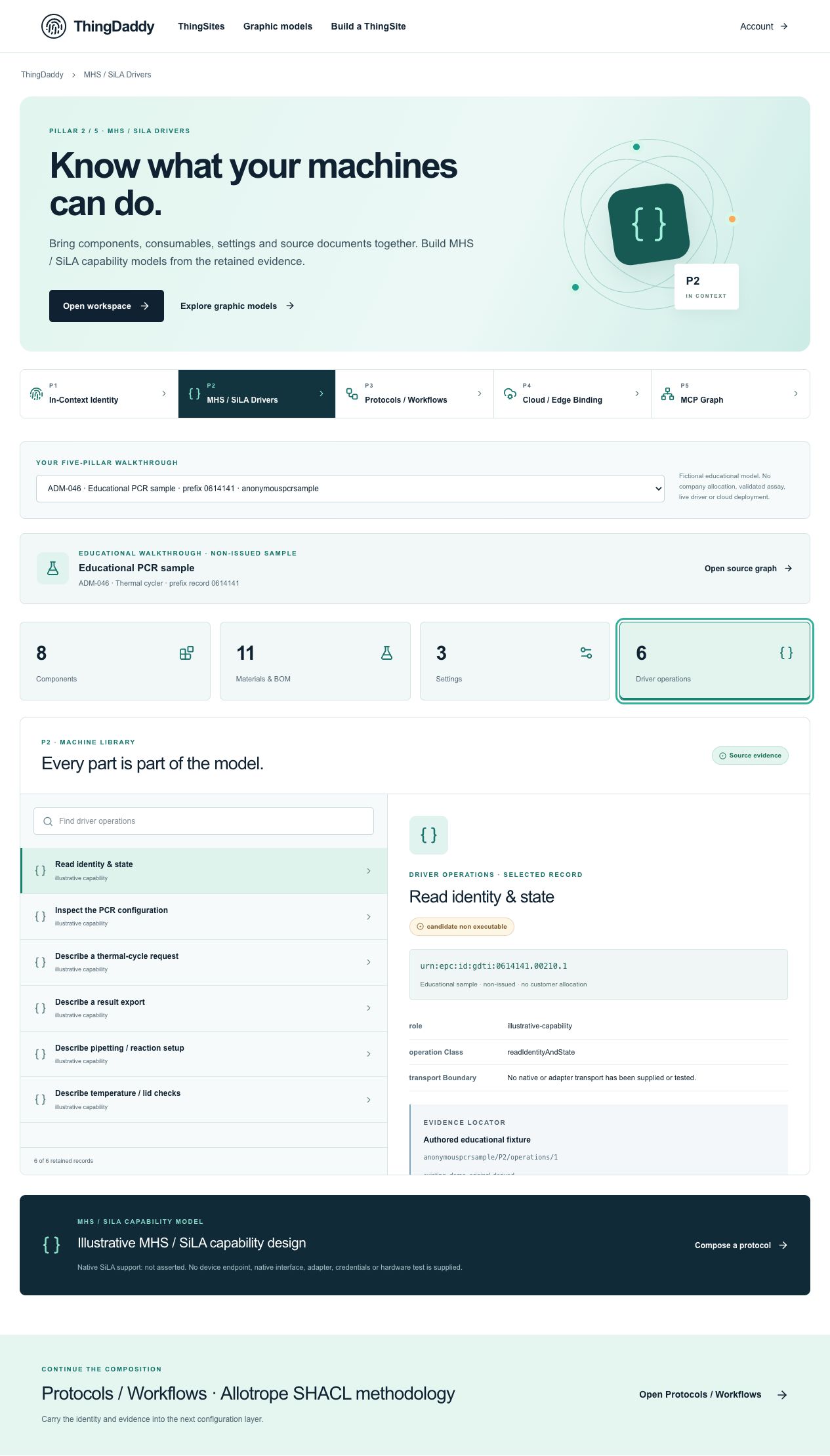
Earlier anonymous demonstration capture · Earlier local anonymous educational preview; not current physical execution or hosted acceptance · not evidence that this exercise has been performed. Open the image for full resolution.
Screenshot provenance
SHA-256 8d92c8e1575e5c78b8056060e796887fc677906d474ae9bab367b03a6aeb711fCaptured 2026-10-13T06:02:47.711Z. Source-package pin: 2f78a982141bda51ba64ea8ccb3a07f527eec3f77cf89baaa1f05c102197f6fd. Original screenshot bytes preserved.
Step by step
01 Select the capability category
Screen or control: Driver operations
Why: Operation count is definition coverage, not tested-driver coverage.
How: Open Driver operations in P2. Select Describe a thermal-cycle request.
What you should see: The definition has operationClass proposeThermalCycle, a candidate GDTI and a no-tested-transport boundary.
Verify: Record #/P2/mhsSilaDriver/operations/2 and do not relabel this as Start run.
02 Inspect its declared inputs and output
Screen or control: Download this source record
Why: A request requires context and approval evidence, not just an operation name.
How: Download the operation and read inputs, outputs, componentRoles, transportBoundary and executionAuthorized.
What you should see: Inputs include Reaction layout and Approved profile required; the output is a Thermal-cycle request draft.
Verify: There is no measured amplification curve, command receipt or native endpoint in this record.
03 Compare export and inspection definitions
Screen or control: Describe a result export · Describe temperature / lid checks
Why: Different capability purposes must keep separate identities and evidence requirements.
How: Inspect these two operation records and download either one. Compare their operationClass, inputs and outputs.
What you should see: A result-export description is distinct from required sensor/interlock evidence.
Verify: Do not count required sensor evidence as sensors responding or a result package definition as actual measured results.
04 Read the driver-wide boundary
Screen or control: MHS / SiLA capability model banner
Why: A library-wide missing transport affects every proposed hardware operation.
How: Scroll to the driver banner and read Native SiLA support and transportBoundary. Check the public package driver fields.
What you should see: Native support is not asserted; driverHardwareState is unknown; no physical dispatch has been supplied.
Verify: Write a transport-readiness checklist instead of attempting a hardware call or claiming a connected driver.
What is happening under the surface
The library contains six authored operation descriptions. Their state is candidate_non_executable.
An operation’s GDTI identifies its definition; inputs/outputs describe required context, not a live request/response trace.
No native or adapter transport, endpoint, credentials or hardware test is supplied; executable and executionAuthorized are false.
Common mistakes
- Never infer native SiLA support from a capability label.
- Do not rename a request draft as an executed experiment.
- A test plan, generated driver document and successful hardware test are different milestones.
The records an agent needs
These are read-only definitions for design review. A real executable driver needs an evidenced interface, bound endpoint, adapter/native implementation, qualified tests and scoped authorization. None is established by selecting a record.
Exact retained identities
urn:epc:id:gdti:0614141.00200.1urn:epc:id:gdti:0614141.00212.1urn:epc:id:gdti:0614141.00213.1urn:epc:id:gdti:0614141.00215.1Anonymous package occurrence pointers
#/P2/mhsSilaDriver#/P2/mhsSilaDriver/operations/2#/P2/mhsSilaDriver/operations/3#/P2/mhsSilaDriver/operations/5Fields or record paths to inspect
operationClassinputsoutputscomponentRolestransportBoundarynativeSilaSupportdriverHardwareStateexecutableexecutionAuthorizedPointers locate records; hashes pin bytes; lesson numbers locate teaching material. None substitutes for an applicable assigned GS1 identity.
Apply what you learned
Draft a non-executable capability review for one operation.
Prepare these outputs
- Exact definition ID, source pointer, input/output list and referenced component roles.
- Explicit missing endpoint, adapter, credentials, acceptance tests and authority.
- A safe next step limited to evidence collection and review.
Review your work against these checks
- The review makes no hardware-dispatch claim.
- Transport and authorization gates remain separate.
- All original operation definitions remain unchanged.
Check your reasoning
What can Describe a thermal-cycle request do in this public library?
This answer stays in page memory, is cleared when you leave, and is not sent or recorded as certification, validation or authority.Source and current boundaries
Screen basis: the anonymous public educational fixture at /api/demo/pillars, namespace 0614141. No private company record is read by this course.
Pinned assessed package SHA-256: b06ee255d0943a048511092595db4b98281b9b761d1910d19e6c3dba82591d94. Its complete graph contains 329 nodes and 231 directed relationships; original excluded assertions remain separately retained provenance. Lesson locators are educational numbers, not issued GS1 keys.
Scope: fictional authored records, non-issued identity proposals, unknown authority, no physical command, assay validation, cloud deployment or execution authorization.
fictional authored, non-issued, read-only
b06ee255d0943a048511092595db4b98281b9b761d1910d19e6c3dba82591d94Open primary referenceReading, answering a question and opening a diagram do not issue identifiers, validate a scientific method, establish company authority, commission an environment or authorize physical action.