2010 · Protocols and participants
Open the exact participant and role behind a step
Use the Participants & materials tab to carry the same exact step, participant and directed assertion into P5 and back.
Open a workspace beside this lesson. Protected links keep their existing access gates; no new permission is granted by this course.
Opening the fixed anonymous evidence graph…
Why this matters
Role labels alone do not establish an identity binding.
Exact cross-pillar continuity lets an agent inspect the referenced unit/context and its assertion provenance.
Read the screen with the explanation
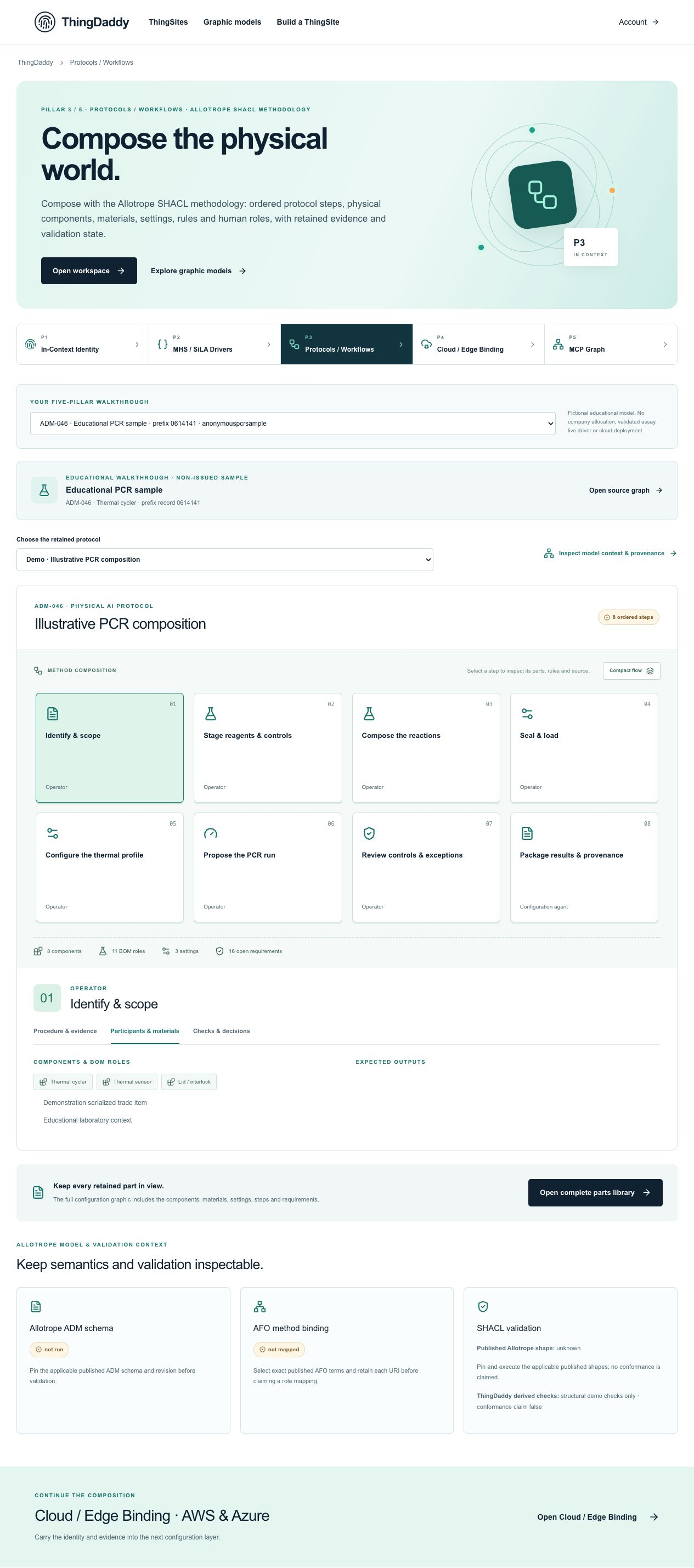
Earlier anonymous demonstration capture · Earlier local anonymous educational preview; not current physical execution or hosted acceptance · not evidence that this exercise has been performed. Open the image for full resolution.
Screenshot provenance
SHA-256 b76647408f8c55f6067dfbc83d418fc97824372a46272779ebd7d52cd166203aCaptured 2026-10-13T06:47:13.990Z. Source-package pin: 2f78a982141bda51ba64ea8ccb3a07f527eec3f77cf89baaa1f05c102197f6fd. Original screenshot bytes preserved.
Step by step
01 Open the intended step
Screen or control: Select exact step 6 in P3 · Participants & materials
Why: Different steps reference different participants.
How: Open the exact step 6 screen link and select Participants & materials. Read both the role chips and Exact participant & service-role assertions.
What you should see: The selected procedure occurrence is #/P3/protocolTemplates/0/ordered_steps/5.
Verify: Do not use a similarly named card from another step as a substitute.
02 Inspect the exact cycler assertion
Screen or control: Thermal cycler asset in the exact participant list
Why: The participant node and the step-participant assertion are separate objects.
How: Select the exact cycler entry. Read Same object. Exact context in P5 and the incoming source occurrence and directed assertion ID.
What you should see: The target node is urn:epc:id:giai:0614141.4; via is urn:epc:id:gdti:0614141.00900.190.
Verify: Record #/P5/edges/189 and verify a is the selected step GDTI and b is the exact cycler GIAI.
03 Inspect service roles without granting permission
Screen or control: Return to the same protocol step · Operator service relationship
Why: A service role must remain distinct from the physical asset and authorization.
How: Return to step 6, reopen Participants & materials and select the operator service relationship. Inspect its exact GSRN and authored relationships.
What you should see: The operator node is urn:epc:id:gsrn:0614141.4343434343; its record does not establish employment or execution permission.
Verify: Read unknown authority and null/unknown time. Do not translate “referenced” into “authorized”.
04 Verify reversible continuity
Screen or control: Return to the same protocol step
Why: A drill-down should preserve the original learning context.
How: Use the P5 return link. Confirm the selected step title and source occurrence before opening another participant.
What you should see: P3 selects the original exact step definition rather than its first/default step.
Verify: Compare the before/after GDTI and pointer. The tab may return to its default Procedure & evidence; re-open Participants & materials explicitly.
What is happening under the surface
componentRoles and bomRolesUsed are retained teaching labels; the exact participant list is derived only from directed references-step-participant graph assertions.
The selected run-step list includes a cycler GIAI, component CPIs, material SGTINs and separate operator/configuration-agent GSRNs.
The link carries node, from and via. The receiver verifies the exact step pointer and directed relationship instead of matching a name.
Common mistakes
- A role chip cannot by itself resolve an exact asset.
- Do not infer compatibility, installation, ownership or permission from a step-participant reference.
- The return link restores the exact definition, not every transient tab or scroll setting.
The records an agent needs
The query is a navigation request, not an identity assertion. Only an existing directed step-to-participant edge qualifies. Unknown parameters, mismatched endpoints and other source lanes are rejected within this public model.
Exact retained identities
urn:epc:id:gdti:0614141.00105.1urn:epc:id:giai:0614141.4urn:epc:id:gsrn:0614141.4343434343urn:epc:id:gdti:0614141.00900.190Anonymous package occurrence pointers
#/P3/protocolTemplates/0/ordered_steps/5#/P5/edges/189#/P5/nodes/1#/P5/nodes/23Fields or record paths to inspect
node query parameterfrom query parametervia query parameterabtprovenancePointers locate records; hashes pin bytes; lesson numbers locate teaching material. None substitutes for an applicable assigned GS1 identity.
Apply what you learned
Trace one physical participant and one service role from step 6 to P5 and back.
Prepare these outputs
- Two target IDs, exact from pointer and via relationship IDs.
- Original edge endpoint/provenance fields.
- A return-check screenshot showing the exact step selected.
Review your work against these checks
- Both target nodes come from retained directed assertions.
- No join is based on a label.
- The original step GDTI remains the return address.
Check your reasoning
Why does the participant link carry a via relationship ID?
This answer stays in page memory, is cleared when you leave, and is not sent or recorded as certification, validation or authority.Source and current boundaries
Screen basis: the anonymous public educational fixture at /api/demo/pillars, namespace 0614141. No private company record is read by this course.
Pinned assessed package SHA-256: b06ee255d0943a048511092595db4b98281b9b761d1910d19e6c3dba82591d94. Its complete graph contains 329 nodes and 231 directed relationships; original excluded assertions remain separately retained provenance. Lesson locators are educational numbers, not issued GS1 keys.
Scope: fictional authored records, non-issued identity proposals, unknown authority, no physical command, assay validation, cloud deployment or execution authorization.
fictional authored, non-issued, read-only
b06ee255d0943a048511092595db4b98281b9b761d1910d19e6c3dba82591d94Open primary referenceReading, answering a question and opening a diagram do not issue identifiers, validate a scientific method, establish company authority, commission an environment or authorize physical action.