2018 · Graph and agent inspection
Read a directed relationship as its own provenance record
Inspect a protocol-version relationship, its exact ID, endpoints and authority scope without inferring identity equivalence or current approval.
Open a workspace beside this lesson. Protected links keep their existing access gates; no new permission is granted by this course.
Opening the fixed anonymous evidence graph…
Why this matters
Relationships carry claims about two records and need their own evidence.
Agent traversal must preserve direction, actor, source, time and scope rather than a generic “connected” label.
Read the screen with the explanation
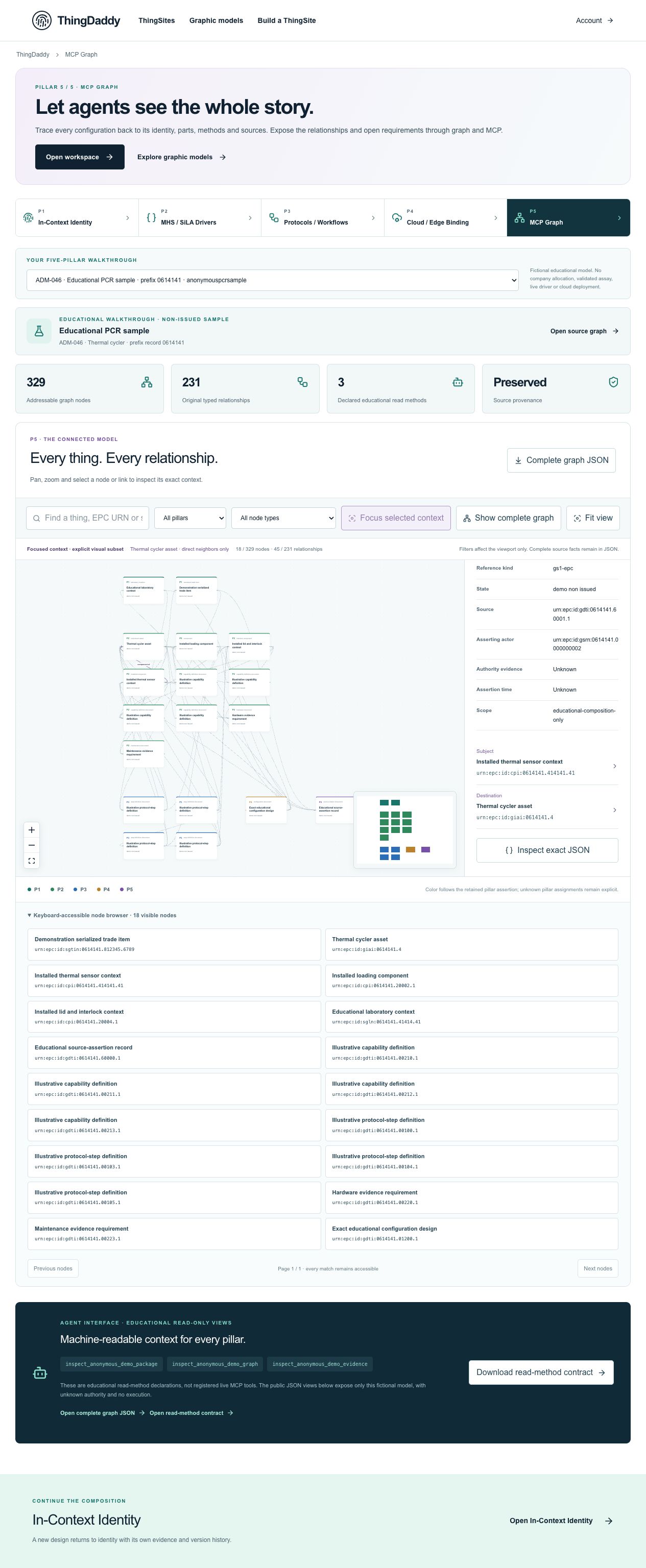
Earlier anonymous demonstration capture · Earlier local anonymous educational preview; not current physical execution or hosted acceptance · not evidence that this exercise has been performed. Open the image for full resolution.
Screenshot provenance
SHA-256 9e0b3abbcedb1f124e4c4f0aa5ec22f49da011179a1fa2fe6f2ca7c4b2b4e650Captured 2026-10-13T05:32:04.733Z. Source-package pin: 2f78a982141bda51ba64ea8ccb3a07f527eec3f77cf89baaa1f05c102197f6fd. Original screenshot bytes preserved.
Step by step
01 Select the version, not a similar title
Screen or control: Protocol-version graph link
Why: Family and version labels can look similar while their identities differ.
How: Open the exact version graph link and read its exact source ID.
What you should see: The selected node is urn:epc:id:gdti:0614141.00011.1; the family urn:epc:id:gdti:0614141.42424.42 remains a distinct node.
Verify: Do not choose a node by title similarity or replace the version ID with its family ID.
02 Open the original lineage edge
Screen or control: Original direct relationships · version of protocol family
Why: The edge, not the node title, supplies the lineage assertion.
How: Select the version-of-protocol-family relationship from the node inspector.
What you should see: The inspector changes to Typed relationship and the selected edge label appears on the canvas.
Verify: Read exact relationship IDurn:epc:id:gdti:0614141.00900.9 and occurrence#/P5/edges/8.
03 Read the directed endpoints and provenance
Screen or control: Subject · Destination · Inspect exact JSON
Why: The direction and scope define what was actually asserted.
How: Inspect Subject, Destination, asserting actor, source, time and scope. Open exact JSON to confirm a, b and t.
What you should see: a is the version, b is the family, t is version-of-protocol-family; original unknowns remain unchanged.
Verify: Record the named source/asserting-actor IDs without treating them as verified real company authority.
04 Traverse without identity replacement
Screen or control: Destination
Why: A relationship connects records without merging them.
How: Select Destination to inspect the protocol family, then locate its incoming version relationship.
What you should see: The family’s own exact ID appears; the original version and relationship remain retrievable.
Verify: Your receipt must preserve all three addresses. No approval, ownership transfer or current-version designation is inferred.
What is happening under the surface
The protocol-version GDTI points to its family through version-of-protocol-family.
The relationship has its own GDTI 00900.9, original source-pointer occurrence and provenance object.
The assertion is fictional authored, scope educational-composition-only, assertionTime:null, authorityState:unknown and executionAuthorized:false.
Common mistakes
- Do not reverse a and b based on visual position.
- Do not invent a timestamp, validity interval or supersession event absent from the source.
- A relationship GDTI is not one of its endpoint identities.
The records an agent needs
The graph exposes original directed assertions. A version-of relationship is not a statement that the family and version are identical, that the version is currently approved, or that any physical run is authorized.
Exact retained identities
urn:epc:id:gdti:0614141.00011.1urn:epc:id:gdti:0614141.42424.42urn:epc:id:gdti:0614141.00900.9urn:epc:id:gdti:0614141.60001.1urn:epc:id:gsrn:0614141.0000000002Anonymous package occurrence pointers
#/P5/nodes/31#/P5/nodes/30#/P5/edges/8#/P5/edges/8/provenanceFields or record paths to inspect
idabtprovenance.sourceIdprovenance.assertingActorIdprovenance.scopeprovenance.assertionTimeprovenance.authorityStateprovenance.executionAuthorizedPointers locate records; hashes pin bytes; lesson numbers locate teaching material. None substitutes for an applicable assigned GS1 identity.
Apply what you learned
Write a relationship provenance receipt suitable for exact agent traversal.
Prepare these outputs
- Relationship ID and zero-based occurrence pointer.
- Original subject/destination/type and source/asserting-actor IDs.
- Unknown authority/time and no-execution states, with a complete traversal back to both endpoints.
Review your work against these checks
- All original addresses remain separate.
- Direction and source scope are reproduced exactly.
- No inferred current approval, ownership or identity equivalence is added.
Check your reasoning
What does version-of-protocol-family establish here?
This answer stays in page memory, is cleared when you leave, and is not sent or recorded as certification, validation or authority.Source and current boundaries
Screen basis: the anonymous public educational fixture at /api/demo/pillars, namespace 0614141. No private company record is read by this course.
Pinned assessed package SHA-256: b06ee255d0943a048511092595db4b98281b9b761d1910d19e6c3dba82591d94. Its complete graph contains 329 nodes and 231 directed relationships; original excluded assertions remain separately retained provenance. Lesson locators are educational numbers, not issued GS1 keys.
Scope: fictional authored records, non-issued identity proposals, unknown authority, no physical command, assay validation, cloud deployment or execution authorization.
fictional authored, non-issued, read-only
b06ee255d0943a048511092595db4b98281b9b761d1910d19e6c3dba82591d94Open primary referenceReading, answering a question and opening a diagram do not issue identifiers, validate a scientific method, establish company authority, commission an environment or authorize physical action.