2030 · Whole-site journey and practice
Complete an end-to-end evidence review
Produce an inspectable explanation of one composition and its readiness limits.
Open a workspace beside this lesson. Protected links keep their existing access gates; no new permission is granted by this course.
Opening the fixed anonymous evidence graph…
Why this matters
A client should finish able to explain the solution through its records, not only repeat the five pillar names.
The next appropriate action depends on the evidence actually present. A well-documented hold is often more useful than an unsupported “ready” label.
Read the screen with the explanation
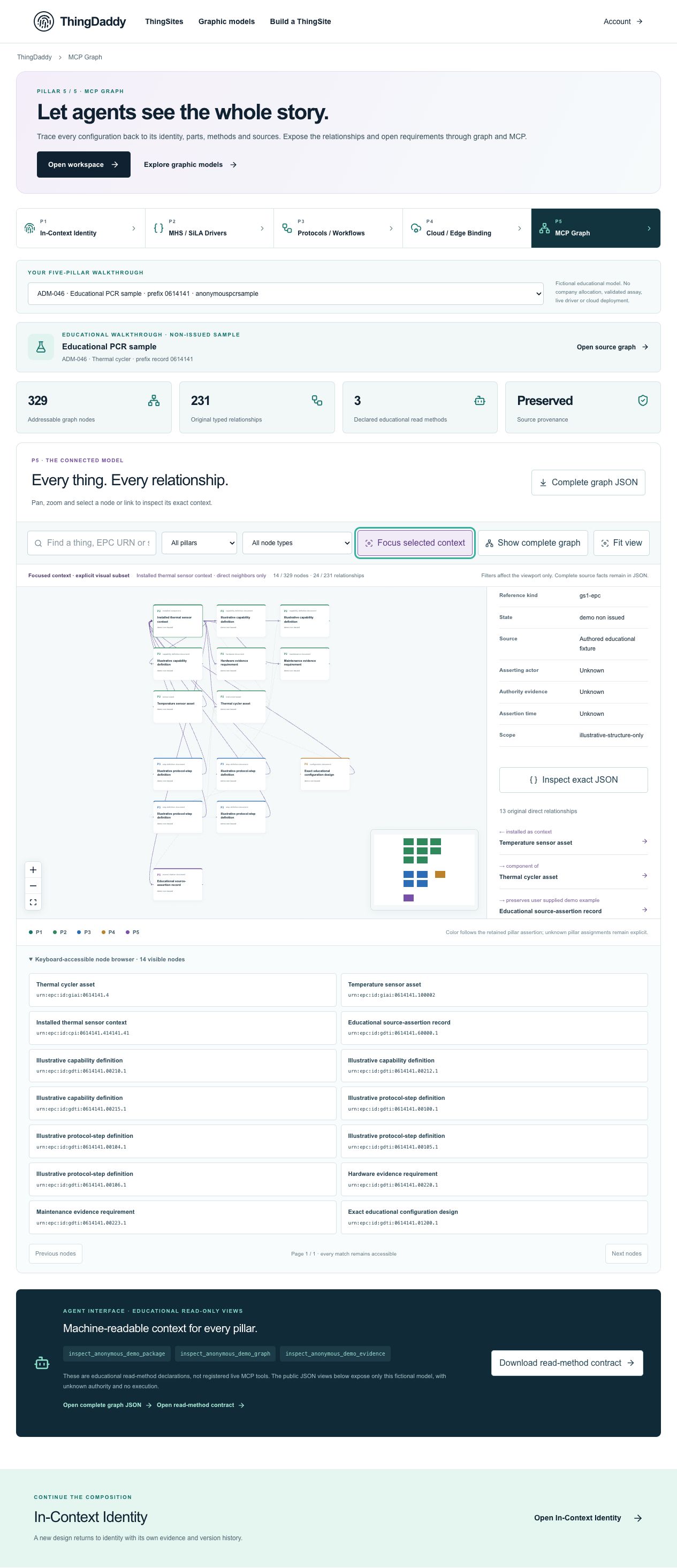
Earlier anonymous demonstration capture · Earlier local anonymous educational preview; not current physical execution or hosted acceptance · not evidence that this exercise has been performed. Open the image for full resolution.
Screenshot provenance
SHA-256 2130a90223e5cff8a005b2142694871b52a52de36aecd34231c54c122a85e073Captured 2026-10-13T05:33:28.273Z. Source-package pin: 2f78a982141bda51ba64ea8ccb3a07f527eec3f77cf89baaa1f05c102197f6fd. Original screenshot bytes preserved.
Step by step
01 Choose the exact composition
Screen or control: Propose the PCR run and Participants & materials
Why: An exact step and directed participant assertion make the review reproducible.
How: Open the named educational step. Select its exact thermal-cycler participant and record the retained step GDTI, asset GIAI, relationship identifier and source pointer.
What you should see: A precise entry into the composition.
Verify: Do not replace any identity with a model name or a file hash.
02 Follow the complete context
Screen or control: P5 node/edge inspector and complete JSON
Why: A focused graph can clarify the context while preserving all original facts.
How: Inspect the selected record and a directed relationship. Record actor, authority, time, scope and unknowns, then restore the complete graph and compare its total with the focused subset.
What you should see: A source-bound explanation and a known viewport scope.
Verify: No original records were discarded by focus or filtering.
03 State the next governed step
Screen or control: Readiness discussion and evidence checklist
Why: Publication and education must not be mistaken for commissioning.
How: List what the sample demonstrates, what requires customer review and what requires actual instrument/cloud testing. Choose one missing evidence item to request within its proper authority scope; do not send the request or grant access from this exercise.
What you should see: A concrete review package with explicit limits.
Verify: The next step does not infer ownership, approval or execution permission.
What is happening under the surface
The evidence review retains exact participants, their capabilities and source documents, protocol family/version, selected configuration, operating design and provenance.
Identity assignment, customer authority, method validation, executable transport, environment binding and physical action are separate decisions with separately recorded evidence.
Common mistakes
- Using a green presentation state as an execution permit.
- Claiming the capstone checked a private fixture it did not inspect.
The records an agent needs
These exact retained references identify the illustrative step, participant and directed assertion. They stay non-issued and do not represent an executed service instance.
Exact retained identities
urn:epc:id:gdti:0614141.00105.1urn:epc:id:giai:0614141.4urn:epc:id:gdti:0614141.00900.190Anonymous package occurrence pointers
#/P3/protocolTemplates/0/ordered_steps/5#/P5/nodes/1#/P5/edges/189Fields or record paths to inspect
stateprovenanceassertingActorIdauthorityEvidenceassertionTimescopePointers locate records; hashes pin bytes; lesson numbers locate teaching material. None substitutes for an applicable assigned GS1 identity.
Apply what you learned
Write a one-composition review that an agent and a client can both follow.
Prepare these outputs
- Exact P1–P5 references and source pointers.
- A distinction between full and focused graph scope.
- Original assertions, current assessments and explicit missing evidence.
- One scoped next-step recommendation.
Review your work against these checks
- Every claimed relationship is inspectable.
- Unknowns and non-issued states remain explicit.
- No hardware/cloud action, scientific approval or authority grant is claimed.
Check your reasoning
What is the capstone’s completion evidence?
This answer stays in page memory, is cleared when you leave, and is not sent or recorded as certification, validation or authority.Source and current boundaries
Capstone over the fixed anonymous sample. No real unit, scientific result or new service instance is created.
Reading, answering a question and opening a diagram do not issue identifiers, validate a scientific method, establish company authority, commission an environment or authorize physical action.