2029 · Whole-site journey and practice
Turn a failed scenario into a measured tool improvement
Plan a test/inspect/adjust/retest comparison with exact before/after evidence.
Open a workspace beside this lesson. Protected links keep their existing access gates; no new permission is granted by this course.
Why this matters
Thousands of generated designs do not show learning unless a measured weakness produces an evaluated adjustment.
A failure can expose a missing diagnostic rather than a proven hardware incompatibility. Preserve the original source state while improving the tool’s assessment.
Read the screen with the explanation
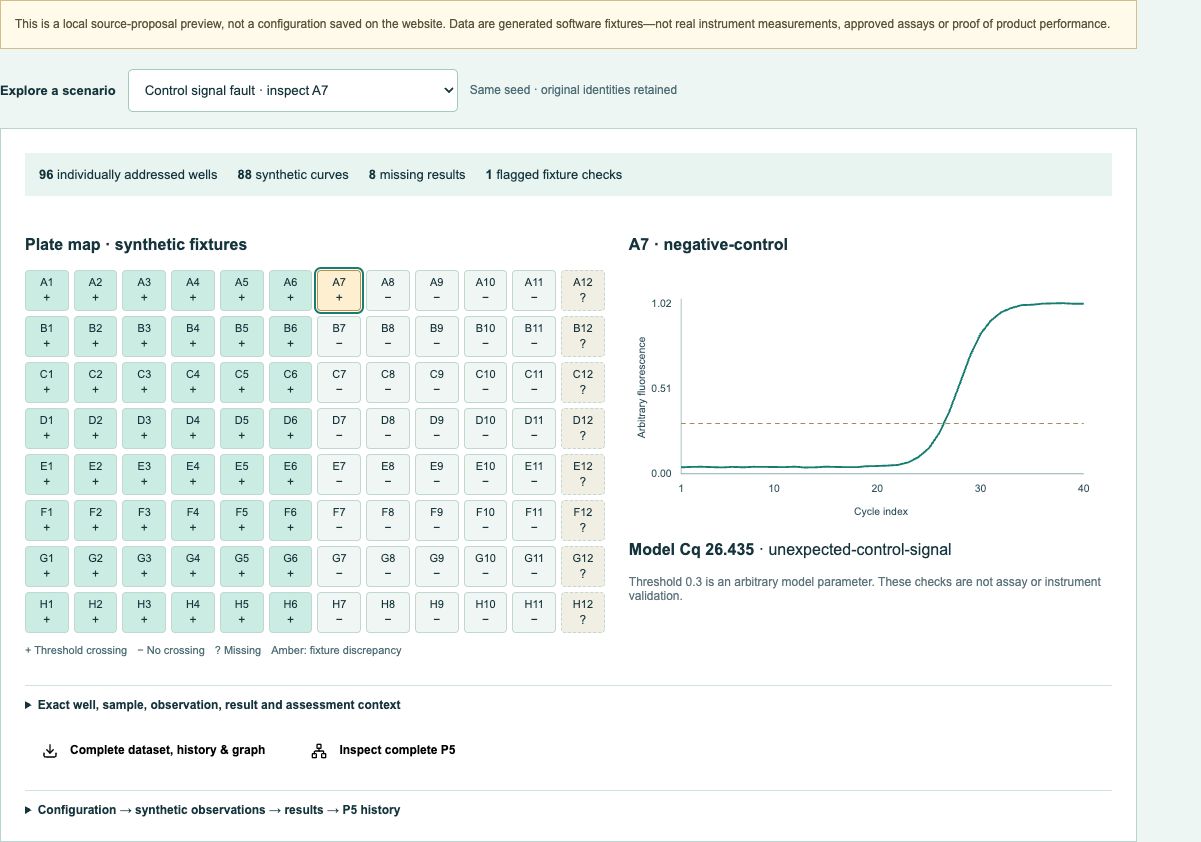
Earlier anonymous demonstration capture · Earlier local anonymous educational preview; not current physical execution or hosted acceptance · not evidence that this exercise has been performed. Open the image for full resolution.
Screenshot provenance
SHA-256 3efdf67a3fc92e80e586d9aadb84eefe2e46d693eaa1ec6ac22f33fa9bafe016Captured 2026-10-13T06:32:30.112Z. Source-package pin: 2f78a982141bda51ba64ea8ccb3a07f527eec3f77cf89baaa1f05c102197f6fd. Original screenshot bytes preserved.
Step by step
01 Choose a reproducible weakness
Screen or control: Practice or source-bound scenario evidence
Why: A vague goal such as “make it work” cannot show whether an adjustment helped.
How: Select one retained software failure or diagnostic gap. Write the exact inputs and measurable expected difference before changing anything. If no supported failure is available, plan the comparison without inventing one.
What you should see: A specific baseline with its verification limit.
Verify: Do not describe an inactive source choice as proven method incompatibility.
02 Propose the narrow adjustment
Screen or control: Recorded change and regression case
Why: The tool should improve its diagnosis without rewriting the source to look better.
How: Describe a specific assessment or validation change and the regression input that exercises it. Keep the source values, rejected proposal and old engine/version evidence.
What you should see: A testable improvement hypothesis.
Verify: No missing fact or compatibility proof is fabricated.
03 Retest the same pinned inputs
Screen or control: Before/after receipts and P5 history
Why: A new unrelated scenario cannot measure improvement in the original case.
How: Compare the same recipes and source pins through the before and after tools. Count actual distinct inputs, executions and checks separately. Record unresolved outcomes and the measured diagnostic change.
What you should see: A reproducible comparison, not only a new screenshot.
Verify: A successful structural replay is not a scientific experiment or weight-training result.
What is happening under the surface
Pin inputs, source snapshot, engine version, commands and expected invariants before comparing outcomes. Keep the failure, adjustment and replay result as separate records.
Structural replay, simulated observations, formal conformance, physical acceptance and model-weight training are different activities. Success in one does not establish the others.
Common mistakes
- Counting repeated checks as new configurations.
- Lowering a gap count by inventing a missing assertion.
The records an agent needs
Feedback is an attributed comparison over pinned inputs. The new assessment must not overwrite the original source or silently reinterpret earlier versions.
Exact retained identities
No assigned value is supplied for this exercise. Do not invent one.
Anonymous package occurrence pointers
No assigned value is supplied for this exercise. Do not invent one.
Fields or record paths to inspect
inputssourcePinsengineVersioncommandsfailureadjustmentreplayResultmeasurementPointers locate records; hashes pin bytes; lesson numbers locate teaching material. None substitutes for an applicable assigned GS1 identity.
Apply what you learned
Design one measured regression experiment for a configuration tool.
Prepare these outputs
- An exact baseline and one proposed narrow change.
- The same-input retest plan.
- Separate configuration, execution, structural and scientific counts.
Review your work against these checks
- The old failure and source survive.
- The measured outcome corresponds to the stated weakness.
- Adaptive learning is not claimed without recorded feedback and evaluated adjustment.
Check your reasoning
What demonstrates a tool improvement?
This answer stays in page memory, is cleared when you leave, and is not sent or recorded as certification, validation or authority.Source and current boundaries
Current configuration-feedback operating rule. This lesson is a comparison exercise, not proof that a learner’s new tool adjustment has been executed.
Reading, answering a question and opening a diagram do not issue identifiers, validate a scientific method, establish company authority, commission an environment or authorize physical action.