2024 · Whole-site journey and practice
Read a private ThingSite one page at a time
Understand the overview and five private pillar pages without merging source records.
Open a workspace beside this lesson. Protected links keep their existing access gates; no new permission is granted by this course.
Why this matters
A private ThingSite is a scoped deployment of context, not simply a company profile. Its overview must lead to independently inspectable source records.
Different source prefix rows can carry different evidence even when their labels look similar. A convenient main view cannot erase either row.
Read the screen with the explanation
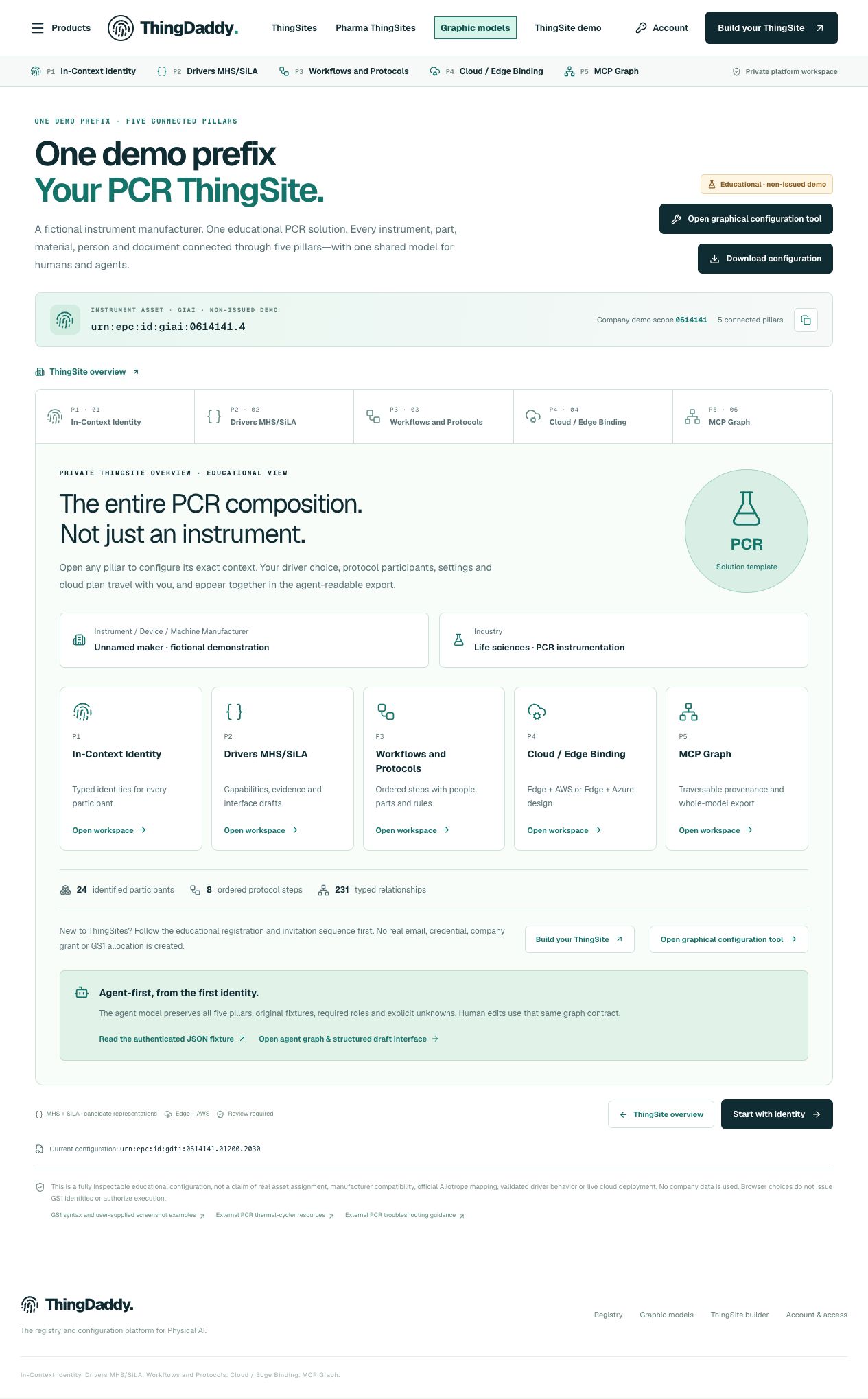
Earlier anonymous demonstration capture · Earlier local anonymous educational preview; not current physical execution or hosted acceptance · not evidence that this exercise has been performed. Open the image for full resolution.
Screenshot provenance
SHA-256 b4a4c8994e164cc88a6cf28628ca187bb8494d891be3f771f2fc2d7258ecdceaCaptured 2026-10-13T06:06:09.781Z. Source-package pin: 2f78a982141bda51ba64ea8ccb3a07f527eec3f77cf89baaa1f05c102197f6fd. Original screenshot bytes preserved.
Step by step
01 Enter the authorized worked example
Screen or control: Private worked example
Why: Named source material belongs in the protected learning area.
How: Use the private course gateway. Existing platform-admin authorization is required; an access-denied page is a valid boundary, not a reason to change permissions.
What you should see: A protected source example or an explicit refusal.
Verify: No named content is copied into the anonymous course.
02 Read overview, then P1 through P4
Screen or control: ThingSite sections navigation
Why: Each page answers a different question about the same selected source.
How: For each page record what is supplied, its original assertion and the current assessment. Keep proposed identifiers and historical notes distinct from assignment and validation.
What you should see: A page-by-page evidence inventory.
Verify: Do not transfer a method or driver to a sibling prefix based on its name.
03 Follow one exact source occurrence into P5
Screen or control: Follow this exact record into P5 and its return link
Why: Same-record navigation prevents a label search from substituting a different assertion.
How: Open a source occurrence, inspect original JSON and relationship provenance, then return to that exact evidence record.
What you should see: The same pointer is visible in both views.
Verify: Original fields and unknowns remain intact; source pairing does not imply validation.
What is happening under the surface
The overview summarizes the selected source context. P1–P4 expose particular evidence, and P5 exposes the retained values and relationships.
An exact source pointer is an occurrence locator, not a GS1 key. A containment/reference graph is not automatically a verified physical configuration.
Common mistakes
- Treating a primary navigation label as identity equivalence.
- Copying historical evidence onto a different prefix row.
The records an agent needs
Private original records and derived occurrence relationships stay separately retrievable. This lesson uses no public copy of a protected company record.
Exact retained identities
No assigned value is supplied for this exercise. Do not invent one.
Anonymous package occurrence pointers
No assigned value is supplied for this exercise. Do not invent one.
Fields or record paths to inspect
sourcePointerassertingActorauthorityEvidencestatusscopesupersessionHistoryPointers locate records; hashes pin bytes; lesson numbers locate teaching material. None substitutes for an applicable assigned GS1 identity.
Apply what you learned
Produce a private page-by-page review of one authorized source record.
Prepare these outputs
- An overview/P1–P5 inventory.
- One exact source occurrence and its P5 return route.
- A separate source assertion/current assessment comparison.
Review your work against these checks
- Private material stays private.
- Original records are not merged.
- Unknown authority and missing transformation evidence are retained.
Check your reasoning
When two source rows have similar names, what should happen to their evidence?
This answer stays in page memory, is cleared when you leave, and is not sent or recorded as certification, validation or authority.Source and current boundaries
This lesson describes the protected source-mirror method without exposing a named company record. The private course preserves historical and current source contexts separately.
Reading, answering a question and opening a diagram do not issue identifiers, validate a scientific method, establish company authority, commission an environment or authorize physical action.