2006 · Capabilities and source evidence
Inspect material roles and retain missing lot evidence
Read the material/BOM list while preserving exact candidate instances, unknown quantities and distinct controls.
Open a workspace beside this lesson. Protected links keep their existing access gates; no new permission is granted by this course.
Why this matters
Materials and controls are participants in a configuration, not decorative inventory.
A plausible reagent name does not establish a validated lot, expiry, dose or compatibility.
Read the screen with the explanation
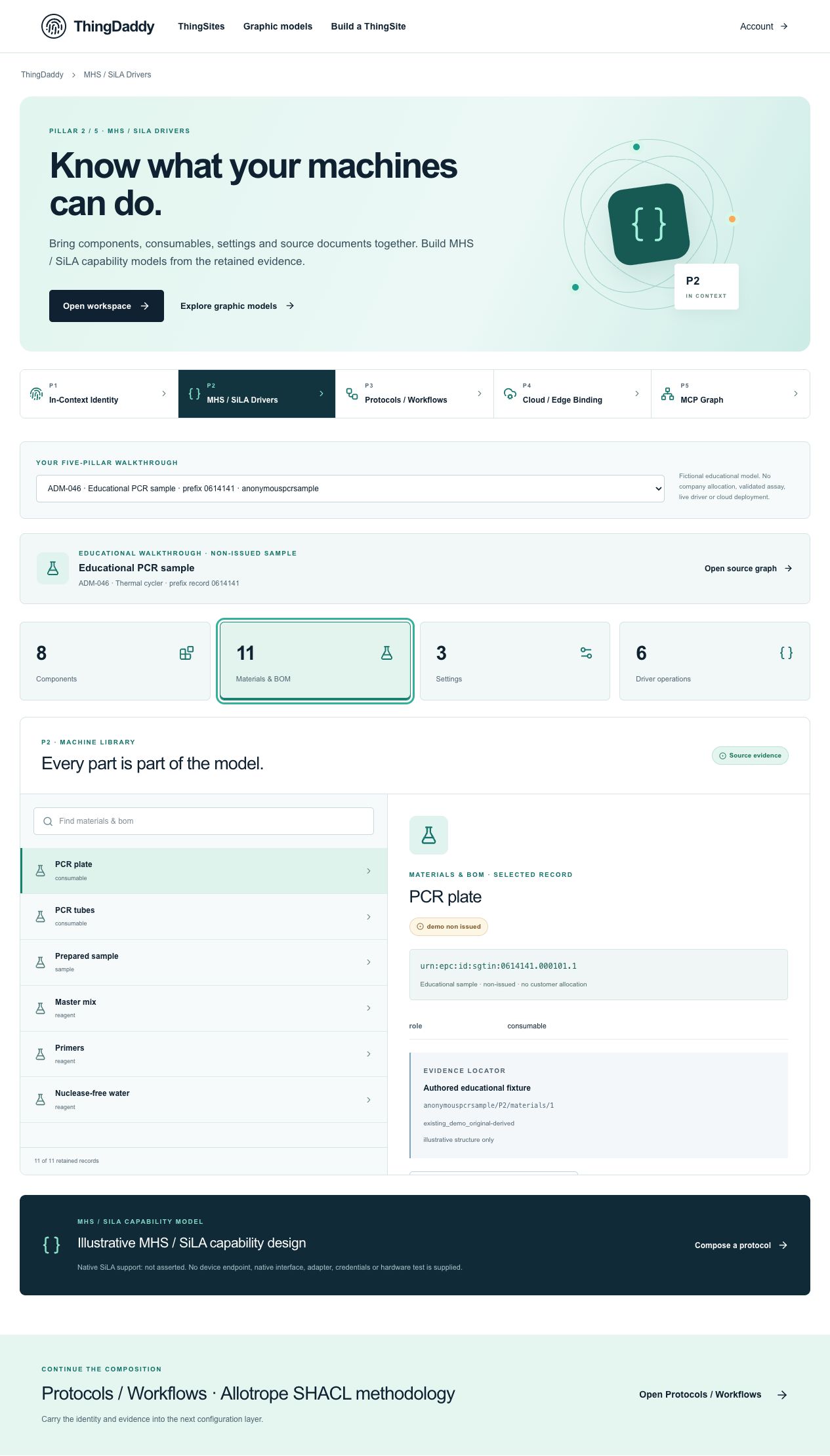
Earlier anonymous demonstration capture · Earlier local anonymous educational preview; not current physical execution or hosted acceptance · not evidence that this exercise has been performed. Open the image for full resolution.
Screenshot provenance
SHA-256 ddd45e409ff21ec33b6158c91f2c3a3f92ce4b8ff2129232bc42f96a475c248eCaptured 2026-10-13T06:02:46.889Z. Source-package pin: 2f78a982141bda51ba64ea8ccb3a07f527eec3f77cf89baaa1f05c102197f6fd. Original screenshot bytes preserved.
Step by step
01 Open the BOM roles
Screen or control: Materials & BOM
Why: Material instances need their own identities and evidence.
How: Select Materials & BOM in P2. Inspect PCR plate, then compare it with Reusable rack.
What you should see: The plate has an SGTIN candidate and the reusable rack a GRAI candidate; both are non-issued.
Verify: Record #/P2/bom/0 and #/P2/bom/10, without treating either name as compatibility proof.
02 Keep the controls separate
Screen or control: Search Materials & BOM
Why: A positive-control role and a no-template-control role cannot be merged.
How: Search for control. Select Positive control and No-template control in turn and copy the full candidate urns into separate rows.
What you should see: Two original records remain separately selectable, with different candidate IDs and original pointers.
Verify: Record #/P2/bom/6 and #/P2/bom/7; no measured signal or assay result is displayed.
03 Inspect fields not promoted by the visible summary
Screen or control: Download this source record
Why: Omitted summary fields must not become invented defaults.
How: Download one control source record. Inspect quantity, lot, expiry and compatibilityState in its record object.
What you should see: The first three values are null and compatibilityState is unknown.
Verify: Write unknown rather than zero, an empty lot string, a guessed expiry date or a default material quantity.
04 Open the exact material context
Screen or control: Open this exact record in P5
Why: The graph can expose how this material is referenced by protocol steps.
How: From the selected control record open P5 and inspect its retained direct relationships. Read each relationship type and exact step destination/source.
What you should see: P5 uses the exact SGTIN node and authored step-participant relationships.
Verify: Keep relationship provenance and unknown authority attached; do not convert references into an assay approval.
What is happening under the surface
The public list contains eleven materials/BOM records. Most use sample SGTINs; the reusable rack uses GRAI.
quantity, lot and expiry are null. compatibilityState is unknown.
The positive control and no-template control are separate material-role records, not observed positive or negative measurements.
Common mistakes
- A control role is not a control result.
- Missing quantity is not zero quantity.
- A rack and reaction-container label cannot establish fit, contamination control or physical compatibility.
The records an agent needs
The downloadable original record exposes null fields that the small UI summary does not render as measured values. Preserve explicit unknowns when building a downstream material requirement table.
Exact retained identities
urn:epc:id:sgtin:0614141.000101.1urn:epc:id:sgtin:0614141.000102.1urn:epc:id:sgtin:0614141.000108.1urn:epc:id:grai:0614141.00301.1Anonymous package occurrence pointers
#/P2/bom/0#/P2/bom/6#/P2/bom/7#/P2/bom/10Fields or record paths to inspect
candidateIdentifier.urnquantitylotexpirycompatibilityStateevidencePointers locate records; hashes pin bytes; lesson numbers locate teaching material. None substitutes for an applicable assigned GS1 identity.
Apply what you learned
Make a material readiness checklist for plate, rack and both controls.
Prepare these outputs
- Four exact identities with original source pointers.
- Unknown quantity/lot/expiry and compatibility fields.
- Specific evidence requests needed before a real site could select these materials.
Review your work against these checks
- Positive and no-template controls remain separate.
- No missing value is invented.
- The checklist is a design review, not scientific instructions or product-performance evidence.
Check your reasoning
What does lot:null in a control record mean?
This answer stays in page memory, is cleared when you leave, and is not sent or recorded as certification, validation or authority.Source and current boundaries
Screen basis: the anonymous public educational fixture at /api/demo/pillars, namespace 0614141. No private company record is read by this course.
Pinned assessed package SHA-256: b06ee255d0943a048511092595db4b98281b9b761d1910d19e6c3dba82591d94. Its complete graph contains 329 nodes and 231 directed relationships; original excluded assertions remain separately retained provenance. Lesson locators are educational numbers, not issued GS1 keys.
Scope: fictional authored records, non-issued identity proposals, unknown authority, no physical command, assay validation, cloud deployment or execution authorization.
fictional authored, non-issued, read-only
b06ee255d0943a048511092595db4b98281b9b761d1910d19e6c3dba82591d94Open primary referenceReading, answering a question and opening a diagram do not issue identifiers, validate a scientific method, establish company authority, commission an environment or authorize physical action.