2014 · Environment and bindings
Read service mappings and proposed data paths
Connect the physical composition, edge proposal, cloud pattern and provenance graph while retaining unbound endpoints and design-only flow states.
Open a workspace beside this lesson. Protected links keep their existing access gates; no new permission is granted by this course.
Why this matters
A service name needs a role in the composition, not just a logo.
Data movement needs identity, source, sink, runtime and governance context.
Read the screen with the explanation
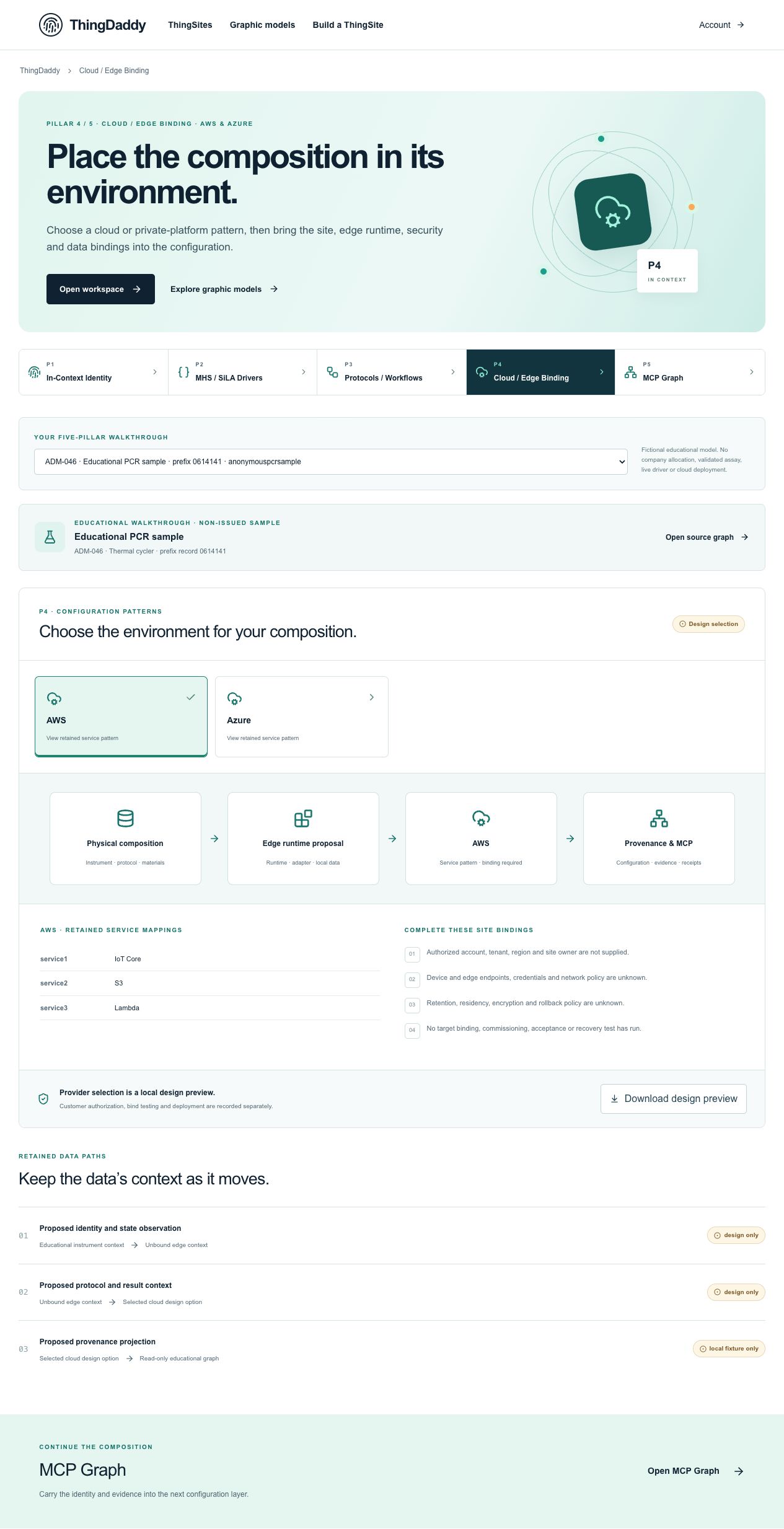
Earlier anonymous demonstration capture · Earlier local anonymous educational preview; not current physical execution or hosted acceptance · not evidence that this exercise has been performed. Open the image for full resolution.
Screenshot provenance
SHA-256 81e0cfc6a87aaa54d18478c25fd3fee99c83111f4b63fd3dbecb0bec5d2023eeCaptured 2026-10-13T05:13:48.156Z. Source-package pin: 2f78a982141bda51ba64ea8ccb3a07f527eec3f77cf89baaa1f05c102197f6fd. Original screenshot bytes preserved.
Step by step
01 Read the chain left to right
Screen or control: P4 environment map
Why: Each layer contributes context without replacing the previous layer’s identities.
How: Open P4 and follow the four diagram boxes. Read the text under Edge runtime proposal.
What you should see: The edge stage is a runtime/adapter/local-data proposal, not a qualified deployed host.
Verify: Do not rewrite the proposal label as an installed adapter or verified edge service.
02 Inspect the selected mappings
Screen or control: AWS · retained service mappings
Why: Service names alone do not establish a physical-to-cloud integration.
How: Read service1–service3 under AWS. Compare the list with #/P4/cloud/candidatePatterns/0/serviceBindings in package JSON.
What you should see: IoT Core, S3 and Lambda remain retained pattern names.
Verify: Note that an account, region, endpoint, credentials and binding-test receipt are not supplied.
03 Read proposed data-path states
Screen or control: Retained data paths
Why: A flow diagram must retain whether movement is proposed or observed.
How: Scroll to the three data-path rows. Read source, sink and current state for each.
What you should see: Identity/state observation and protocol/result context are design-only; provenance projection is local-fixture-only.
Verify: Record #/P4/flows/0, /1 and /2 separately. Do not state that observations were transmitted.
04 Trace the exact environment definition
Screen or control: AWS design-document graph link · Inspect exact JSON
Why: A P4 design artifact must remain an addressable document in P5.
How: Open the exact AWS design-document node in P5 and inspect its retained relationships and source evidence.
What you should see: The design GDTI remains part of the same anonymous graph, with authored evidence and unknown authority.
Verify: Distinguish this document identity from a real cloud resource identifier or deployment event.
What is happening under the surface
The diagram shows Physical composition → Edge runtime proposal → selected cloud option → Provenance & MCP.
The source serviceBindings are generic retained mappings, not actual endpoints or operational integrations.
Three flow records retain source, sink and currentState. Two are design-only and provenance projection is local-fixture-only.
Common mistakes
- A source/sink label is not a configured URL or host.
- A cloud-pattern GDTI does not identify a created cloud resource.
- A proposed provenance projection is not a live MCP connection or executed upload.
The records an agent needs
The edge-host GIAI candidate is an identified participant in the broader composition, not proof that an adapter or service is running. The proposed flow records are separate from observed network transfers.
Exact retained identities
urn:epc:id:gdti:0614141.00401.1urn:epc:id:giai:0614141.100003Anonymous package occurrence pointers
#/P4/cloud/candidatePatterns/0/serviceBindings#/P4/flows/0#/P4/flows/1#/P4/flows/2#/P5/nodes/36Fields or record paths to inspect
serviceBindingssourcesinkcurrentStatedesignDocumentauthorityStatePointers locate records; hashes pin bytes; lesson numbers locate teaching material. None substitutes for an applicable assigned GS1 identity.
Apply what you learned
Create a proposed data-flow review with explicit gaps at every boundary.
Prepare these outputs
- Three source/sink/state rows with exact source pointers.
- The selected provider mappings and design-document GDTI.
- Missing endpoint, runtime, security and transfer-evidence requirements.
Review your work against these checks
- Every flow remains design-only or local-fixture-only as supplied.
- No observed traffic or live service is invented.
- Physical identities are not replaced by generic cloud service labels.
Check your reasoning
A data-path row says currentState:design-only. What does it mean?
This answer stays in page memory, is cleared when you leave, and is not sent or recorded as certification, validation or authority.Source and current boundaries
Screen basis: the anonymous public educational fixture at /api/demo/pillars, namespace 0614141. No private company record is read by this course.
Pinned assessed package SHA-256: b06ee255d0943a048511092595db4b98281b9b761d1910d19e6c3dba82591d94. Its complete graph contains 329 nodes and 231 directed relationships; original excluded assertions remain separately retained provenance. Lesson locators are educational numbers, not issued GS1 keys.
Scope: fictional authored records, non-issued identity proposals, unknown authority, no physical command, assay validation, cloud deployment or execution authorization.
fictional authored, non-issued, read-only
b06ee255d0943a048511092595db4b98281b9b761d1910d19e6c3dba82591d94Open primary referenceReading, answering a question and opening a diagram do not issue identifiers, validate a scientific method, establish company authority, commission an environment or authorize physical action.