2026 · Whole-site journey and practice
Bind an exact participant and compare undo, redo and reload
Understand reversible local configuration state without confusing it with server history.
Open a workspace beside this lesson. Protected links keep their existing access gates; no new permission is granted by this course.
Why this matters
A role requirement and a selected asset are different objects. The chosen participant needs its exact identity and a proposed binding, not just a matching label.
Undo/redo and local restoration are useful editing behaviors. They must not be described as durable private server version history.
Read the screen with the explanation
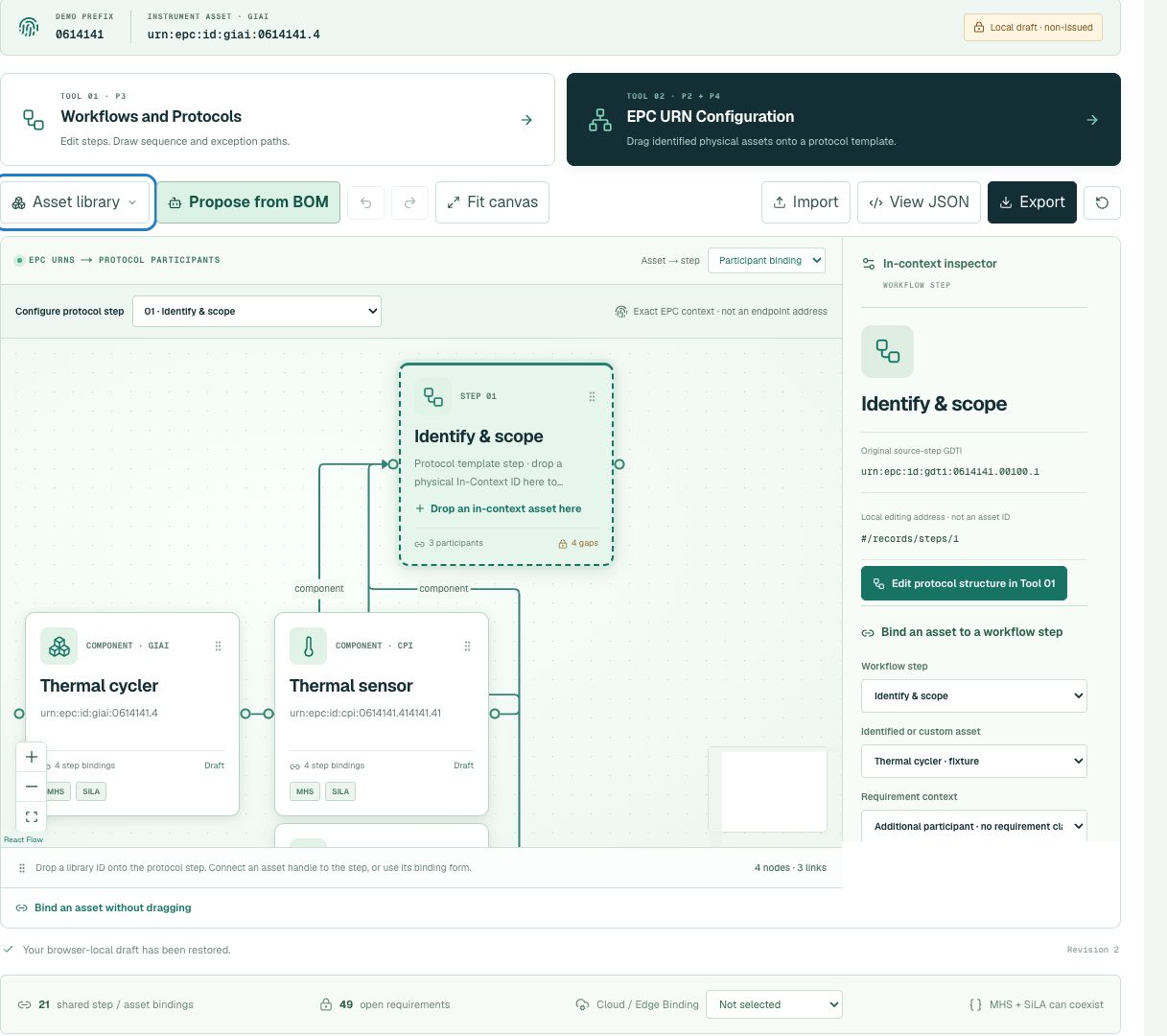
Earlier anonymous demonstration capture · Earlier local anonymous educational preview; not current physical execution or hosted acceptance · not evidence that this exercise has been performed. Open the image for full resolution.
Screenshot provenance
SHA-256 1fff8d4c82238479ceee138476e4facdfe67c154b44de077d707ff856ceb986aCaptured 2026-10-13T06:28:36.785Z. Source-package pin: 2f78a982141bda51ba64ea8ccb3a07f527eec3f77cf89baaa1f05c102197f6fd. Original screenshot bytes preserved.
Step by step
01 Inspect an existing asset requirement
Screen or control: In-Context Asset Configuration and the selected step
Why: A model-level need does not select a particular physical unit.
How: Read the step’s role and requirements. Inspect an exact library item and its identifier before using an Add or binding control. If applicability is unknown, preserve that gap.
What you should see: A separately identified role, candidate participant and proposed association.
Verify: No name-only join or inferred compatibility is introduced.
02 Make one reversible proposal
Screen or control: Add binding, Undo design change and Redo design change
Why: The learner needs to see the recorded change, not only a new line on the canvas.
How: Use one available safe educational binding operation. Record the target and participant, undo it, then redo it. Do not remove or reset a pre-existing unrelated draft.
What you should see: The local proposal changes and returns as expected.
Verify: The original source identities and values are unchanged in each state.
03 Inspect restoration and export
Screen or control: Export and reload
Why: Restoration tests a particular persistence layer. It does not prove every other layer.
How: Export the local draft before reloading. Compare the restored draft and the session undo controls. Explain that durable server-save lineage needs a separate immutable receipt and protected retrieval test.
What you should see: A precise account of local restoration behavior.
Verify: Do not call a local reload an authenticated server-save proof.
What is happening under the surface
The asset library retains exact references. Adding an asset or binding is a proposal, not installed-use or compatibility proof.
A browser-local persisted draft, session undo history and an immutable server receipt are distinct kinds of state.
Common mistakes
- Treating a drawn edge as installation evidence.
- Counting redo as a second scientific experiment.
The records an agent needs
Selected identities and proposed bindings must stay distinct. This browser-local exercise is separate from server-owned private configuration receipts.
Exact retained identities
urn:epc:id:giai:0614141.4Anonymous package occurrence pointers
No assigned value is supplied for this exercise. Do not invent one.
Fields or record paths to inspect
draft.assets[*].urndraft.assets[*].sourceIddraft.bindings[*].iddraft.bindings[*].stepIddraft.bindings[*].assetIddraft.bindings[*].requirementIddraft.commandLog[*].commandPointers locate records; hashes pin bytes; lesson numbers locate teaching material. None substitutes for an applicable assigned GS1 identity.
Apply what you learned
Make one local participant proposal and compare its three editing states.
Prepare these outputs
- Exact role, candidate identity and binding target.
- Before, after, undo and redo observations.
- A statement identifying the persistence layer actually tested.
Review your work against these checks
- Original source facts survive.
- Unresolved applicability remains unresolved.
- Only local behavior is claimed.
Check your reasoning
Does local restoration prove immutable server version history?
This answer stays in page memory, is cleared when you leave, and is not sent or recorded as certification, validation or authority.Source and current boundaries
The exercise requires an already-authorized local educational studio; it changes no company source or online permissions.
Reading, answering a question and opening a diagram do not issue identifiers, validate a scientific method, establish company authority, commission an environment or authorize physical action.